
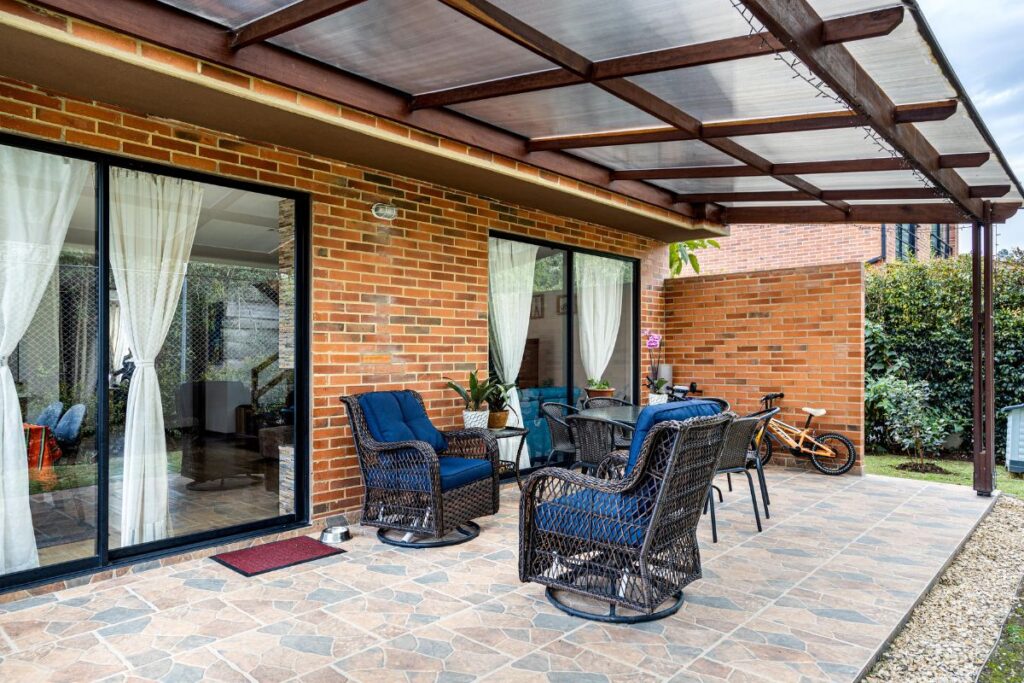
Most people choose a patio roof based on a photo they saw somewhere, then live with the consequences for the next twenty years. That is a shame, because the choice between polycarbonate and metal is not really about looks. It is about whether you want your outdoor space to feel like a bright conservatory or a cool, shaded retreat, and about what you are willing to put up with when it rains.
Both materials work. Both are sold at every hardware store and by every patio builder in the country. The difference is that they solve slightly different problems, and knowing which problem you have makes the decision much easier.
The short version
If you are pressed for time, here is the summary before the detail.
Polycarbonate suits shaded yards, small courtyards, spaces where you grow plants, and anyone who does not want their kitchen window to go dark. Metal suits hot climates, west-facing patios, homes near the coast, and anyone who wants a roof they can forget about for thirty years. Cost sits in a similar range for mid-tier products, so budget is rarely the deciding factor on its own.
What you are actually buying
The two products behave very differently once they are up, so it helps to know what each one is made of.
Polycarbonate
Polycarbonate is a tough, translucent thermoplastic sold in two main forms. Corrugated sheeting is the thin, single-layer profile you see on most budget verandahs. Multiwall sheeting has internal ribs that create air pockets, which makes it stiffer, better insulated and considerably more expensive. Both are available in clear, opal, grey, bronze and heat-blocking tints.
The material is impact resistant to a degree that surprises people. A hailstone that dents steel will usually bounce off polycarbonate. What it does not resist forever is ultraviolet light, which is why quality sheets carry a co-extruded UV layer on the sun-facing side and why cheap sheets go yellow and brittle after a handful of summers.
Metal
Metal patio roofing is almost always steel with a zinc or zinc-aluminium coating, or aluminium where salt exposure is a concern. It comes in corrugated, ribbed and standing seam profiles, finished in a baked-on paint system that carries its own warranty separate from the substrate.
It is opaque, structurally strong, and it spans further between supports than polycarbonate does, which can mean fewer posts cluttering your patio.
Light: the difference you will notice first
This is where the two materials genuinely diverge, and it is the factor most homeowners underweight.
A polycarbonate roof lets between 10 and 90 percent of light through depending on the tint you choose. Clear sheeting keeps a small courtyard from feeling like a cave and stops the rooms behind it going gloomy. If your patio sits against a south-facing wall, or your yard is already shaded by neighbouring buildings and trees, polycarbonate is often the only sensible answer.
Metal blocks light completely. In a hot, bright climate that is exactly what you want, and the deep shade underneath is part of the appeal. In a dark, narrow space it can make the whole rear of the house feel closed in. Builders often solve this with a hybrid: a metal roof with two or three polycarbonate sheets set into the run, which gives you shade with a skylight effect.
Heat, and why tinted polycarbonate is not the same as shade
Light and heat travel together, which creates the main practical complaint about polycarbonate.
Clear sheeting transmits a great deal of radiant heat, so a polycarbonate patio in full afternoon sun can become uncomfortable by mid-January. Heat-reducing tints and multiwall products help significantly, but they never match the performance of an opaque roof.
Metal absorbs heat rather than transmitting it. The sheet itself gets hot, though the space underneath stays noticeably cooler, particularly with light-coloured finishes and an air gap or insulation blanket above. If your patio faces west and you actually want to sit out there in summer, metal wins this category outright.
Rain noise
Everyone asks about this, and the honest answer is that both are louder than a tiled roof.
Metal produces the classic drumming sound during heavy rain. Plenty of people love it. Plenty of others find it makes conversation impossible during a downpour. Insulation blankets and thicker gauges reduce it, but they do not eliminate it.
Polycarbonate is generally louder still, especially thin corrugated sheeting, because there is less mass to absorb the impact. Multiwall polycarbonate performs better than single-layer sheets thanks to the air chambers.
If quiet matters to you, budget for an insulated metal system and be sceptical of anyone who tells you a patio roof will be silent.
Lifespan and what goes wrong
The two materials fail in completely different ways, which is worth knowing before you commit.
Quality polycarbonate lasts roughly 10 to 20 years. It yellows, it becomes chalky, and eventually it cracks around the fixings where it has been expanding and contracting through thousands of temperature cycles. Cheap sheets can start looking tired in five years.
Metal roofing lasts 30 to 60 years depending on the coating and how close you live to salt water. Its failure mode is corrosion, which starts at cut edges, scratches and fixing points. Choose the right coating grade for your location and it simply keeps going.
Matching the roof to the rest of the house
Something worth thinking about before you order anything is how the patio cover will look against your existing exterior, because a bolted-on structure that clashes with the house tends to date badly.
Metal has a clear advantage here. Many of the same corrugated and ribbed profiles sold as metal siding panels are produced for roofing in matching colours and finishes, so you can carry one material language across the walls, the shed and the patio cover instead of introducing a fourth texture. If you are already planning cladding work, ordering both at once also keeps the colour batch consistent, which is harder to fix than it sounds once the panels are installed.
Polycarbonate has less to offer visually. It reads as a functional element rather than an architectural one, which is fine on a rear courtyard and less ideal on a street-facing extension.
Cost
Prices vary by region and installer, so treat these as relative rather than absolute.
Single-layer corrugated polycarbonate is the cheapest option available. Standard corrugated metal sits slightly above it. Multiwall polycarbonate and standing seam metal both land in the premium bracket, and the gap between them is small. Where the numbers really separate is over time: a polycarbonate roof will likely need replacing once during the life of a metal one, so the cheaper option is not always cheaper.
Installation costs are broadly similar, though metal spans further and may need fewer posts and beams, which can offset its higher material price.
Choosing between them
Rather than a scorecard, it helps to match the material to your situation.
Choose polycarbonate if your yard is shaded, your patio is small, you are covering a plant area or spa, natural light into the house matters to you, or you want the lowest possible upfront cost.
Choose metal if you get strong afternoon sun, you want genuinely cool shade, you live near the coast or in a hail-prone area, you want the roof to match your home’s cladding, or you would rather spend more once than replace it in fifteen years.
Consider a hybrid if you want shade over the seating area and light closer to the house, which is the most common compromise builders install and usually the one people are happiest with.
A last thought
The polycarbonate versus metal patio roofing question rarely has a wrong answer, only a mismatched one. Spend a weekend paying attention to where the sun lands on your patio at three in the afternoon, and how dark the room behind it feels at breakfast. Those two observations will tell you more than any product brochure.